Australian Sound Artist
tattered-kaylor.com
Showing posts with label Recordings. Show all posts

Thursday, June 19, 2014

Day two at Pollinaria

:: Ground floor @ Pollinaria ::


Tuesday 17th June.

With such short time the recording has well and truly begun. The wet weather is a typical hindrance - it seems every country I have visited in the last two years - my recordings have included rain - no matter what time of the year it is. Water is a wonderful sound to record but it would be nice to have the choice - and that is a little harder than usual to master this time round. 

Last night I 'warmed-up' by recording some of the creaking doors of the farmhouse. Ground floor of the building is a fantastic space whose inner architecture is not dissimilar to a miniature representation of le abbey Noirlac and the acoustics leave you with the same sensation of 'other-worldliness'. Natural acoustics and creaks are like treats to me so it was nice to find them here and begin the sound collection with them. This time round I indulged my typical desire to go against the textbook recommendation of recording technique - close mic'ing the door extremely so, with a hyper-cardioid. I am pretty chuffed with the result - a hyper-surreal sensation of listening through a microscope to the point that the original sound - as authentic as it is, is completely unrecognisable and bizarre. Your instinct to identify the sound swings from assurity (Oh yes - that's a door) to sheer doubt and questioning as the sound's envelope progresses (what the hell is that?)

This morning was the dawn chorus with Daniella. We started a little later than usual as the sky was so overcast that even the birds were slow to get started. The nearby valley is an excellent haven for birds and shelter from the noise of nearby roads and I think the best recording will be the very first.

:: Bean recording - contact mics ::
The afternoon was spent in the closest shed where giant bags of black beans used for fertilising the soil, and wheat seed for planting are to be found. Cue, the contact mic's and we had some very textural rolling rumbles created as I moved my hands through the beans. Taking the microphones in hand, I'd plunge them deep into the bags and then pull-back - yoiking them out just as quickly. The timbrel shift linked to the speed of the hands was not unlike a doppler effect and made me think of breathing…

:: Recording Daniela making pasta ::
Night time was spent drinking vino rosso with Gaetano and further discussing the project. After a few glasses, Daniella decides we MUST record the sounds of making pasta, to then be eaten for dinner. Out with the contact mic's again and she goes to work. It is a beautiful thing to see. 'Oh no! I am not a stereotype!', she promises me as she cooks away - her hands moving deftly in movements she seems well practised in. "Not all Italians cook pasta", she promises. I understand, but as a visiting auzzie, I would like to let myself continue imagining that perhaps in some parts of Italy, they do….  

Saturday, May 10, 2014

Hydrophone Test #2

:: Hydrophone cable connected to Neutrik NA2MBNC adapter ::
The part 'B' of an earlier test I did with the Teledyne Reson TC 4033 hydrophones. Again - long overdue but well worth the wait. As a quick recap - the first test entailed doing a small series of recordings with the hydrophones in a controlled environment (my bathtub), using Raimund Specht of Avisoft's preamps #42003, recording onto my trusty Sound Devices. I won't go into more detail as if you want to know more tech specs etc. please have a look at the original blog entry - it's all in there!


For these final test-recordings I set-up exactly as per Test #1, with the only variable being the exchange of the #42003 preamps for 2 x Neutrik NA2MBNC adapters (see image above) and the input gain db's. Water was at the same level/temperature. The sounds I recorded  entailed pouring water into the bathtub using the same jug and with the exact same technique as last time. Ideally, I would have done these tests using four inputs and the two setups - recording simultaneously each event as it occurred but this was not possible purely because of gear access. I was lucky enough to have two of the hydrophones but not four.... The next best method would have been to record both tests one after the other, with no delay in-between - but unfortunately I did not have the adapters at the time of the first test - nor did I know that I would want to further explore the hydrophone's sound quality in this method - not until I had completed Test #1. So here we are with the next best thing - me attempting to mimic in every way - the original methods the only (conscious) variables being the controlled gain level on the 788T and the preamp-swapped-for-adapter. 

Hope this makes sense......

After Test #1 I was concerned with a slight humm that was coming through on my recordings - particularly when the input gain was above 38db. After assuming it was from the preamp, I decided to try the recordings with a simple adapter and compare the two results. I knew from the off-set that gain levels on the 788T would need to be a lot higher - ultimately driving their preamps a lot harder. You could say I was really testing the preamps.... Avisoft Vs Sound Devices....

Key differences between the preamps and the adapters include the fact that unlike the preamps, the adapters do not have a high-pass cutoff controlled by a rotary pot, nor do they amplify the sound in any way. Their function is purely as a port adapter, from BNC to XLR so as to connect into the recording device. By using a simple adapter (as opposed to a cable) not only is it most likely cheaper, but it retains the quality of the signal conducted by the high-quality hydrophone cable - right up to the recording device.

All were recorded one following the other, in the exact same conditions with the only variable between them being the gain on the 788T. You'll notice that the starting gain level is 20db more, than Test #1... Other than converting files to MP3 @ 320kbps for the audio players I have left them completely untouched.


FIRST RECORDING
Gain: 54.7


SECOND RECORDING
Gain: 58


THIRD RECORDING
Gain: 62


FOURTH RECORDING
Gain: 66.4


FIFTH RECORDING
Gain: 68.5


SUMMARY: The sound quality facilitated by the Avisoft preamps becomes abundantly clear when comparing the recording results. These preamps ensure that the delicate details of low frequencies are well presented and preserved as can be best experienced when listening to the bubbles rising through the water. The general recording level is also quite adequate. Louder levels are possible but with the compromise of the humm (this may be able to be reduced in post-record editing). In comparison - using only the adapters acted almost as a lowcut at around 160Hz. In addition to this loss of lower frequencies the general level of the recorded sound was well below what the 788T's preamps could managed to successfully boost without a noticeable and destructive hiss of noise interference coming through. Even when keeping the 788T's gain at low levels so as to try to avoid increasing the noise floor, the recorded sound was almost too low to be useful. I will say that the higher frequencies of the recordings that were gathered using the adapters (as opposed to the preamps) were noticeably more crisp - but still - just too low. If I was recording very loud sounds of the range >700hz then the adapter-setup might suffice.... Ideally though - I would suggest the TC 4033 teamed with Raimund Specht's #42003 preamps - which I have a new level of respect for.

THANKS: To the helpful people of Teledyne Reson - particularly Tom Mortensen and Brian Burge who so patiently answered all my questions. To Raimund Specht of Avisoft for taking the time to put together such useful pieces of speciality recording equipment and again - for helping me nut out all my answers...

Saturday, March 1, 2014

North East England: Sonic Postcard NEE04

:: NEE04 - Blowhole, Howick area 12th November 2013. Water - and fragile booming ::


Recording Technical Specifications:
Recording device: Sound Devices 788T
Microphones: DPA 4060 (stereo pair)

Tuesday, February 25, 2014

North East England: Sonic Postcard NEE03

:: NEE03 - Caris Clocks, Alnwick Town 15th Nov, 2013. General clock-ticking ambience and gentle chimes ::


Recording Technical Specifications:
Recording device: Sound Devices 788T
Microphones: DPA 4060 (stereo pair) and DPA4017
Multichannel recording and mixdown

Recording taken within Caris Clocks, Alnwick. Time keeper is 4th generation clock repairer, Gordon Caris. His son is 5th generation. Lovely sounds of ticking, a few gentle chimes. Clocks are irregular with their times (they are in for repairs...) so chiming is a bit erratic.

Many-thanks to Gordon for accommodating that which was so unfamiliar......

Sunday, February 23, 2014

Hydrophone Test #1

:: Hydrophone Test #1 ::

For almost three weeks now I've had a pair of the much coveted Teledyne Reson TC 4033 hydrophones sitting on my studio floor and waiting to be tested. Today was the day where I woke to find basic getting-by essentials had been caught up with for the time being, (food; check, money; check, cleanliness-factor; check-ish-will-do-for-now-hey-it's-the-weekend-I-don't-need-to-shower/change-for-anyone-today-anyway), so I was finally allowed to get back to my real work.......

I think it's safe to say that at a certain point in a field recordists practice they get their hands on a hydrophone and the less-known world of auditory sensation begins to reveal itself. If you are like me, this experience never leaves you only providing more fuel to the fire of your sonic-gathering obsession. 

And so begins the hunt for your very own hydrophone.

My hunt began in 2009 when on attendance at a 'Chris Watson' masterclass at the Wired lab I experienced the DPA 8011 and my world was changed forever. These hydrophones were ceased from production in 2011 (? there abouts) - which despite the fact this was not really relevant to me (there was no way I could afford such high quality equipment anyway) - still saddened me in that there seemed to be a gap in (almost) affordable, high quality hydrophone technology, that needed to be filled.  


**A word of advice: The final 'kit' that I have been fortunate enough to be able to access for testing took quite a bit of research and phonecalls to far-away lands. If you have technical questions about such specialised gear then calling the company direct is the way to go. While Australian distributors may do their best to help it's not safe to assume they know ALL the answers. After some confusion I made the direct call to discover that the hydrophones I was originally envisioning purchasing would require an additional two hardware modules (small boxes but...) and connecting cables in order to function. The Australian sales person I spoke was not aware that this was the case.


Item #1 & #2 - hydrophones: The TC 4033. 
:: TC4033 ::
While it is still a long-term, once-in-a-lifetime investment that means you won't be eating for a few years (let's not forget you typically want TWO of them for stereo...). Their price is less than that the DPA 8011 was and the sound quality (while not as crisp) is still miles above the other truly affordable, domestic/high quality models that I have had the pleasure of experimenting with. Unlike Teledyne Reson's pricier-but-impressive TC 4032 model, the TC 4033 does not have an inbuilt preamp that requires 9V power. TR do sell preamps that can be used with the TC 4033 BUT, these also require 9v power (an external battery box) and more money to purchase them with....


Item #3 & #4 - preamps: Avisoft's Charge amplifier and high pass filter #42003
:: Avisoft's preamp #42003 ::
As a solution to the loss of recording level I decided to try Raimund Specht's (Avisoft) pre amps. The #42003 model runs off the phantom power of your recording unit and connects in via BNC and out via XLR. Unfortunately there is not a stereo module so I used two of them (as per the image). On looking at the modules in person there were two aspects I was not too sold on. The first is the fact that there is no setting to completely bypass the high-pass filter - you have to use it no matter what (and I typically do not like to use any filters on original field recordings). Second, the high-pass settings on the rotary knob were marked by an attached sticker that was very much like a slightly heavier-than-usual piece of paper. As these preamps work with hydrophones it's safe to assume there will be water around. It would only take one wet hand touching the label for it to start to deteriorate and the general wear and tear of moving your portable recording kit around would only assist this process.  I'd much prefer the industry standard of engraving the numbers into the module itself. 


Item #5 - recording device: Sound Devices 788T
:: Sound Devices 788T with Avisoft's 42003 preamps ::
-With fresh firmware update and recording at 24bit/96K, my favourite recording tool..............................


The following are three sample recordings for you. All were recorded one following the other, in the exact same conditions (see top image) with the only variable being the gain on the 788T. Other than converting files to MP3 @ 320kbps for the audio players I have left them completely untouched.


FIRST RECORDING
Gain: 34.7
Preamp high pass cut-off: 10Hz


SECOND RECORDING
Gain: 38
Preamp high pass cut-off: 10Hz


THIRD RECORDING
Gain: 42
Preamp high pass cut-off: 10Hz


SUMMARY: I'm very happy with the frequency response of the hydrophones. The few affordable models I have tested often lack responses below 100Hz so I am glad to hear there is nice depth to these recordings and a sharp crispness to the high's. The preamps were very handy in that they solved two problems that arose from these hydrophones. First is the problem of recording level - the boost was wonderful and the second, was the conversion from BNC to XLR. They achieved both of these things whilst also being powered by phantom power - whereas other preamps required an external power box to drive them. As handy as this was - I am a bit concerned about the humm that comes through. This becomes more apparent as the gain increases on the 788T. I normally record general ambience at a gain of about 50 so that fact that the humm was well and truly present at 42 was noted. Having said that though - the next step will be for me to try the hydrophones with an impedance transformer (no preamp at all) and see how they perform. I'm hoping that as I have the quality preamps in the 788T that I may be able to get as much level as with Avisoft's preamps but without the humm.

TBC............ 

Sunday, November 24, 2013

North East England: Sonic Postcard NEE02

:: NEE02 - Barter Books, the old Alnwick train station 4th November 2013. General shop ambience and Moozak with the train set running above and over the book shelves ::


Recording Technical Specifications:
Recording device: Sound Devices 788T
Microphone: DPA 4060 (stereo pair)

Saturday, November 16, 2013

North East England: Sonic Postcard NEE01


:: NEE01 - Boulmer Stones 11th November 2013. Tide is rising. I am standing on volcanic stones while the waves come in and wash around me ::


*Please note: On streaming the sound there is noticeable dithering and high frequency artefacts. On downloading the sound itself, these artefacts should not be present.

Recording Technical Specifications:
Recording device: Sound Devices 788T
Microphone: DPA 4060 (stereo pair)

Tuesday, November 12, 2013

Winter Sounds of North East England

:: Recording site. North East Coastline, England ::


Recording England's wildlife in Winter is quite a challenge - particularly if wildlife is not your speciality. Unlike Australia (that seems to house a constant crowd of critters all year round), come Winter time in England a number of birds disappear. Along with the Winter closure of buildings whose acoustics I'd hoped to capture, these have been the two biggest hurdles that have arisen throughout this trip. On a positive note, what these unexpected 'exclusions' have given me is a shift of gaze from the obvious splendour of local historic castles and as-yet unheard (to me) birdcall - to the turning cogs in the local community that keep it ticking along year-in and year-out. I mentioned in an earlier post - the blessing-in-disguise of missing the tourism trade times and I think I am still only just beginning to appreciate the impact this will have on my work (with only four days to go....). 

Before I leave I hope to capture the sounds of the local trade. Its butchers it's bakers, its clock makers - those who have lived and worked in this part of the world their whole lives. After chatting to a number of local tradespeople I have found that they are often 3rd or 4th generation in a family business local to the area. It's quite touching to come to this gentle realisation - with each (sometimes a bit awkward) conversation that I have. These families are a part of the past, present and future of these towns. Their names may be found on a street name as they have become inexplicably interwoven into the history of their place of living. Quite a realisation to someone who has lived in four states in the past seven years (ish?) and countless houses... 

In contrast to the sound of industry I am also gathering the sounds of the beautifully wild and wooly nature that sustains the local communities. Crashing waves, churning waters and howling winds are all a part of the soundscape. Today I went recording near Craster, at the old Bathing House on the coastline. I had looked at images of the area but didn't have much of an idea about what to expect - except that the abundant nesting community of birds would not be present (Winter!). What I discovered was beautifully sculpted volcanic stones that have been carved over thousands of years - by the waves of the ocean. Their shapes looked mechanical, artificial and completely organic - all at once. Trying not to slip I managed to clamber on top of a raised ledge and hang my microphones down into carved pools and blow holes as the tide rose. I saw only one person today - an old man who smiled at me but would not speak as we passed each other. It was a beautiful day - with sounds so perfect that even this stranger would not unsettle it with his voice... 

Thursday, November 7, 2013

Day 5. Rock pools and hail of Embleton Bay

:: Embleton Bay ::
Sat 1st Nov. The last day of work with Chris was spent heading along Embleton Bay with the idea being to arrive at Dunstanburgh Castle. Unfortunately we only made it to the foot of the cliff walls - as the castle's grounds begin. The wind, rain and hail had become constant enough as to push us to retreat. I actually revelled in the subtle attack of the elements and if the dark hadn't been approaching (so quickly in the UK!) then I would have happily continued with the hike. I gathered some astonishing sounds of the waves crashing on the shore using Chris's DPA 8011's and attempted to gather the more dynamic sounds from the rock pools but with less success. It seems that the Sound Devices 788T model has a fatal flaw in the the limiters are not available when recording at 96k. This ultimately meant I could not record sounds from the rock pools as their quiets are too quiet and their louds are pure distortion without a limiter. It's worth mentioning that this is the first - ever - downfall that I have found from this model.

:: Recording @ Embleton Bay ::
To record the general sounds I used my old trusty Rode NT4 (stereo). Again, I was disappointed in that there was bad distortion on one channel. What I assumed was wind noise (as you can see - I did not have with me adequate wind jamming gear....) was actually a noise flaw that disappeared once I powered the microphone from the SD's phantom power AND switched the 'ON' switch to 'OFF'. I've never had this problem before and I can say that I won't be making it again but what a frustrating way to learn these beginner errors....... Safe to say - I will be heading back to the Bay and will aim for windy and wild weather when I do so. Night is falling faster and faster so I will be trying to cram my recording sessions in when the light is still present. I'm already dreading the day of 'leaving'. There's so much to record.

The last couple of weeks I will be working on my own and capturing what I can of sounds from the area. It's a strange time to be in Alnwick, the first week of the castle and some surrounding tourist attractions closing down for Winter. In a sense - you could think that I've 'missed it', that I am too late, or, you could think that my timing is perfect, to capture the personal sound signature's specific to this area, devoid of the tourist crowds.

This project has been assisted by the Australian Government through the Australia Council for the Arts, its arts funding and advisory body. 

Tuesday, November 5, 2013

Day 4. Good work habits for the field recordist

:: Home-made windshield ::
Friday 31st Oct. 
I enjoy recording sounds as an artist (no surprises there). By undertaking this work as purely a creative luxury and keeping my, 'day job', I allow myself the choice of when and where I record - to satisfy my own ego and intentions. The downfalls in working in such a manner includes the fact that if you have no one to please but yourself you may feel there is no need to set work practice to any uniform standard. As you will be the only individual working with the material - only you need to know facts, figures, dates, tech specs and you've got all that in your head anyway so no need to formally record it right...? 


Well I know this is not the case - I'm merely playing devils advocate to illustrate just how poor my own work methods can be in regards to recording crucial information and maintaining professional work standards. All of those bad habits are in the past

As      Of      Now

Chris: What do you record at? 
Me: 24/48
Chris: You don't record at 96?
Me: No - you can't hear the difference anyway
Chris: Maybe but why wouldn't you? You have enough disc space and when you consider just how fast technology is developing - the sound standard is only increasing. In future we may very well have 96k as our broadcast standard.
Me: .....
Chris: Do you indent at all?
Me: Oh.. ahh... I try to but I generally forget
Chris: You should always indent at the start of each recording. Say your name, the place, your equipment, the date and any other information you would like to add. Do you know 'Wave Agent'?
Me: ....... head shake
Chris: You should have a look at it. It embeds the required metadata into your files and it's free. You can put all your indent information in there and your sounds are ready to be archived. No information is lost. Have you timecoded your Sound Devices?
Me: Yep
Chris: Let's have a look. Furrowed brow, changing of settings
Me: Silently realise that it's still set to time-in-Australia not, time-in-UK. Cringe.
Chris: You must timecode for every place you visit.
Me: nodnodnod

- and so we continue like this for the rest of the morning. It was a bit of a wakeup call in regards to my lazy habits. When I was working as an AV tech I (like to think I) was thorough with the systems I implemented and installed for others, logic has it that I should at least do the same for myself. 

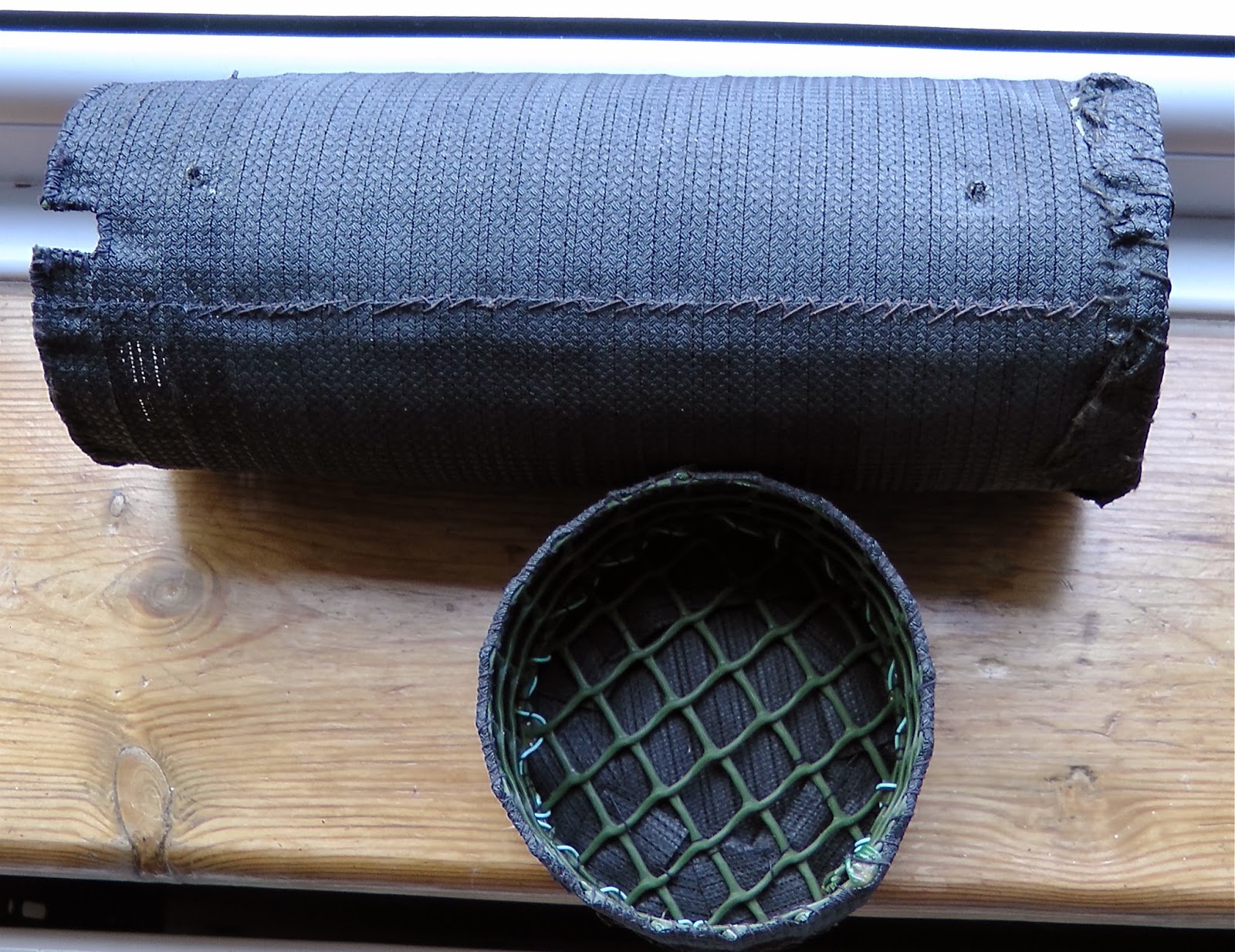
Other tips and tricks Chris enlightened me to include the making of his own windshields (see image above). I have seen this done before but not with speaker fabric (Tygan), for the exterior. This allows the sounds to pass through to the microphone with less frequency filtering. With a simple thread-through and loop of a rubber band you have basic suspension for your microphone and a lightweight shield that won't break the bank or leave you teary eyed if it gets damaged in rough terrain which, as a top paid professional - you mightn't want to use it on set but as a penny-pinching artist.... it's ideal.

This project has been assisted by the Australian Government through the Australia Council for the Arts, its arts funding and advisory body.

Saturday, November 2, 2013

Day 2. The wind and the tide of Lindisfarne.

:: Walking path for the Monks to come and go from the island - marked by tall poles ::
Lindisfarne is a pretty interesting community (an understatement!). It has a recorded history dating back to the 6th century that includes tales of Viking attacks and nothing less than the birth of Christianity. Personally - what I find so intriguing about its nature is the fact that at certain times of the day, when the tide rises, the island is cut-off from the rest of civilisation. To live on the island is to live by the tide and in a rhythm with the elements you have no control over. People have done-so for well over a thousand years and I am sure they will continue to do-so in the years to come. 

The day of my visit (Wed 30th Oct) was windy and overcast - well suited to imagining the past lives that have sustained such a setting. We walked along the coastline - around the island and found one particularly striking place at which to record. 

:: Recording at Lindisfarne ::

The howl of the wind was the most voice-like I have ever heard. The halyards of the nearby boats banged against their masts - sounds ricocheted off the wall to my left. Chris's ears were noticeably quick at picking the spots where sounds were sweetest. Sometimes he would silently point and I would know where to move to listen. At times the wind would be too strong and we would stand to block its full gale, allowing the microphones a chance to absorb the sounds before wind distortion. 

In the late afternoon we headed to a hide that we had scouted earlier in the day. It was close-by, on the coastline and one that Chris had not recorded at before. While it was still light we positioned our microphones and ran the cable back to the hide. By nightfall - as the tide was moving in, so too was the bird wildlife and we began the recording. Over at least an hour, I listened as the sea crept closer and the bird's chatters grew louder. It is not a process you can rush - like the people of Lindisfarne -  we were also living by the tide - at the beck and call of it's own internal clock - a spectator to it as it passed us by. In the distance I could hear the trains passing through each half hour as per their timetable, adding to the pulse of the environment. As the darkness fell so too did the general humm of daily noise. The nocturnal cycle of sounds rose together as an unseen orchestra, hiding in the dark beyond the hide. We sat in a small circle of dim light - only able to listen and imagine what this world entails.


This project has been assisted by the Australian Government through the Australia Council for the Arts, its arts funding and advisory body.

Thursday, October 31, 2013

Day 1. Open your ears, begin again: Recording under the expertise of Chris Watson


After over a year of planning I have finally begun the recording intensive in North East England under instruction from field recordist Chris Watson. My day of travel from London to the coastline was quite an ordeal. Nature decided to make it interesting by throwing a savage storm across my path. Sitting on a unmoving train for over 8 hours with a handful of strangers - while mild panic ensued and the discontent amassed - provided me with a somewhat surreal experience existing somewhere between 'Breakfast Club' and 'World War Z'. At midday, I did a run for supplies, leaving the quiet safety of our cabin to head into the growing mass of desperate bodies trying to leave the city.

I slipped through their numbers to quickly grab what I needed and headed back to the 'Safe zone'. On return I continued conversation with other strangers. Under the pressure of time they unfolded and told me of their relationships with family, friends, partners - more than once I heard the phrase, 'But I can't really talk about it with them.' I'd ask them why they could talk about it with me and generally, they would shrug. I became a confessional for the troubled individuals whose worrying thoughts had risen to the surface in this time of relentless waiting.
Very surreal...

Tuesday morning (29th) the work begins. I arrive at the Watson residence to find that the unconditional infatuation from their border collie (Jessie) has not waned overnight. While I know I'm not the only one (her attention is lavished on any lucky soul that walks through the front door), it does make me feel somewhat special and warrants interrupting my morning cup of tea discussion with Chris for a quick return of affection. We spend the morning pondering over maps of the areas Chris would like to visit for recordings. Each point on the map brings with it a tale of history - of its past and present inhabitants - of clans and cultures - of beasts and birds all who are connected to this physical origin. By the time the car is packed and we begin our way I am aware that tutoring has well begun.

Today we visit one of Chris's 'favourite places to record'. Heading North West we arrive at a small resting place within Kielder Forest. Visually, it is notably modest but the collections of sounds to be sourced here are diverse and like candy for the ear. An active stream borders the edge of the area, which is filled with both native and introduced trees, (pine and broad leaves, respectively). The wind has many different voices - each tuned by the leaves and trunks it wraps itself around. The coniferous trees - with their thin needled leaves create a constant steady hiss - not unlike white noise. The native Oak and Birch trees crackle in the force of the wind, their broader leaves clapping together like hands to near breaking point. 

I drop the two different hydrophones I have with me into the stream at various points. First I try deeper waters - where the current is strong moving but not so rough. The lower frequencies are more present and the general richness of the audio is a pleasure in itself. In comparison - the shallow stream appears to also shallow the frequencies of the sounds. Their lows disappear and the mid/highs become rougher and less enjoyable. Chris talks to me as I am monitoring and I jump at the direct sound of his voice. He reminds me that sounds travels faster in water than air. What I am hearing is his voice through the stream and it's immediacy is so noticeable that I feel I am hearing his voice microsecond's before his mouth forms the words.

:: Hydrophone recording. Kielder Forest ::
We pack up and leave just before dark. We must head to a nearby clearing and position our microphones for the night - running 100m cable back to the vehicle in wait for the nocturnal nightlife whose sounds we hope to capture. Time is of the essence. The setup (once positioned) must be left for at least a couple of hours before we begin recording, so as to allow the environment to settle again after our disruption. So little time, so much life and obsession to record it....


This project has been assisted by the Australian Government through the Australia Council for the Arts, its arts funding and advisory body.

Saturday, August 24, 2013

Tattered Kaylor mix on The Field Reporter


I am very happy to have completed a 2013 mix of the Field Recordings I collected during the In-Habit Residency 2011, for David Valez's, 'The Field Reporter'. These sounds include a previously unreleased (in any capacity) recording of buskers at an annual festival in the small township of Bruere Allichamps.
Find more details about the sounds, have a listen and download the mix HERE
Many Thanks to Cheryl Tipp for inviting me to such an opportunity.

Enjoy,

T

Tuesday, June 11, 2013

Urban London 2013: Sonic Postcards L04-L06

:: L06 - London 7th June 2013. Protest on the steps of the High Commission of South Africa, Trafalgar Square ::


:: L05 - London 8th June 2013. Borough Markets. 3 Crown Market ::


:: L04 - London 8th June 2013. Borough Markets. Green Market ::


Recording Technical Specifications:
Recording device: Zoom H2n
Microphone: Rode NT4 (stereo)

Sounds are available for download on the Freesound website for you to access and comment on them as you wish. 

Thursday, May 30, 2013

Urban London 2013: Sonic postcards L01-L03

:: L03 - London 28th May 2013. Skaters @ Southbank Skatepark ::


I have started gathering sounds for the 'Urban London 2013' collection. These will be posted on Freesound for you to access/comment as you wish. I will also be adding them here as Sonic Postcards.

Recording Technical Specifications are:
Recording device: Zoom H2n
Microphone: Rode NT4 (stereo)
London, May 2013

The recordings sound best on headphones with some beautiful movements from left to right in the Skatepark recordings (above) and again, along the Regents Canal (directly below).

:: L02 - London 25th May 2013. Peering through trees to Regents Canal below ::


The recording, 'Near Festival, by the canal', and 'Festival Inner' both feature the sounds of a festival in Victoria Park that started at about 11am that day. The former, was recorded at a position along the canal whereby the distant sounds of the music from the festival would come and go, between audible and inaudible as the wind would permit. The volume fluctuations are completely natural. Recording was done at a flat input level. The latter was recorded within the festival grounds.

:: L01 - London 25th May 2013. On the way to Festival @ Victoria Park, along Regents Canal ::


I haven't consciously recorded the sounds of a city for years and I was surprised at the inner conflict I had in doing so. Just to be clear - I have recorded the sounds of markets, machinery, live improvisations at night in inner city buildings and trains passing overhead as I am tucked underneath their rolling guts - but to stand in the thick of it, in the middle of the day as traffic and sirens rise to a level that twinges your ears is quite another matter...
- and I didn't really even do that - I still subconsciously discovered pockets of the city that were not completely sonically dominated by the sounds of traffic. 

But who can ignore it? I am standing there, at the edge of the Thames surrounded by swarms of tourists and weekenders and there is not a living critter apart from us, to be seen bar one - a solitary Canada Goose with only one leg remaining, standing remarkably close (too close for his own safety) to a young family who are exploring the shoreline. It was an experience that I can't shake. It's feathers were dirty and uneven and it was obviously tired and not well fed. It wasn't scared of the people only a few meters away - perhaps it's wariness was not as strong as its reasons for watching them. It stood there unmoving, staring at them with a stubborn desperation - I assume it was hoping for food. 

Please don't think I'm particularly targeting London with these thoughts - in any big city you'll find the small critters paying the price of our developed urbanscape. It was a moment of confrontation as I stood there with my microphone, watching this quiet tragedy run its course. I put the microphone down and walked away.

Thursday, February 21, 2013

KunstRadio Commission: Booroomba Rocks Technical

:: Equipment for Booroomba Rocks recording, (minus Quarke the cat) ::
The above is a photo of equipment I took for the Booroomba Rocks recordings, with the addition of leads and minus the cat. The microphones include the new addition to my artillery, the DPA 4023 - matched pair. Items worth pointing out include the Mipro MA101 - a battery powered portable PA, the iPod, the microphone wind jammers and wind socks and the rugged Crumpler Karachi Outpost bag that it all fits in (bar the stand and boompole). The Mipro MA101 is also a new addition that I had not tried out before. Previously I have used battery powered speakers such as the RCF Move100. As light as these are  - they are still incredibly impractical to lug across bushwalking terrain... The Mipro is the same weight and size of a large torch and gets plenty of volume. My biggest complaint would be that despite the advertise frequency response of 60Hz - 15KHz +/- 3db, anything under 90Hz was predictably weakened/not really there. The mids and highs however, were very crisp and LOUD.

The conceptual idea (from a technical approach) was to take the work I had composed using only source material from Uli Kuehn's 'ROBOT', and play it back into this selected space/place (as per it's purpose for creation) in order to record the sonic outcome.

The recordings I did at Booroomba consisted of two stereo paired microphones (four channels in total). The first pair was my tried and true DPA 4060 (omnidirectional), positioned well above headheight, to catch the general surrounds and sound difusion. The second pair was the new DPA 4023's, in ORTF formation, closely positioned to the Mipro to directly catch the playback of the piece in realtime.

:: Recording position ::
:: Recording configuration ::
It was extremely important to me to capture the playback of the composition in it's surroundings as it occurred and likewise, to capture the surroundings as they reacted and conversed with the sounds of the composition. Even I, the most easily pleased listener when it comes to enjoying and discovering the rhythms in everyday sonic occurrences - natural or otherwise - was almost startled by how perfectly,  moments of shift and drama between nature and composition unfolded within the resultant recordings. 

Aspects that I failed miserably in included the positioning of the microphones (a crucial element - I know..). Because of the lack of time and poor weather conditions, equipment positioning was less than ideal. Nerves and rush on setup meant that I pretty much almost just shoved the gear somewhere out of the weather and free of fauna. The PA should have been further away from the 4060 atmosphere microphones, allowing them to capture more subtle diffusions of the playback composition without drowning out the sounds of their surrounding nature. I also wish I had had the time to base the setup right in amongst the trees and shrubs so as to catch the sounds of the rain falling and dripping over them.

Final mistake (another crucial beginners error) was that I did not have adequate wind protection for the DPA 4023's. The recordings suffered terribly for it with not only the grating sound of wind battering a microphone, but also severely limiting just how much time I was able to record (minus the excessive wind). I'd say I know what my next needed piece of equipment will be. Time to start saving (again)......

Sunday, February 17, 2013

KunstRadio Commission: Booroomba Rocks experience

:: Booroomba Rocks, Feb 2013 ::
Last weekend was spent heading to Booroomba Rocks to complete the field recording for the final piece in the KunstRadio commissions. The day ended up being a surreal experience to say the least - with an uncanny amount of participation from Lady Luck at points where it really should have all turned pear-shaped.... As Luck would have it, there was not a soul to be seen at the lookout. I discovered this was not only because of the approaching storm but also due to a festival. Locals and tourists alike headed to Canberra city for the annual Multicultural festival leaving the nature-loving curious to experience their bush surroundings in an eerie stillness, disturbed only by their own trudging of footsteps. 

The storm was a concern. I was nearly hit by lightening once - the world froze in a white light, there was an almighty crack/black and then the world started up again much the same except my hair was smoking/smelt strange and adrenalin was making my legs shake as I ran down the hill. While I was determined to record what I could of the storm, I knew it was unwise to be standing on top of a mountain next to a metal rod while it passed. Distant thunder started while Len and I packed our bags for the walk at the base of the mountain. We made the decision to continue the climb.


I had forgotten the way the bush goes quiet before a storm. The birds stop calling and sometimes - even the crickets cease... It felt ominous - like a preparation of what was to come - a 'battening down of the hatches' for the impending blows. I can't remember it ever being so quiet and here I was, expecting to record sounds. We reached the top, I began scouting for a slightly sheltered space, time became shorter and I realised that there was only a matter of minutes before nature's show would begin. Setup became a bit frantic with the swelling quiet consuming the space of time. As luck would have it, I managed to gather the beginning of the storm as it passed us by - barely clipping us with it's edges - leaving us safe from the lightening and as an awestruck audience on eye level with the clouds as we watched the elements play their part around us. We weren't completely protected - the rain still came and I stopped recording when it turned to hail. The microphones got questionably soaked (I will try them out to make sure they are OK) - but we were extremely lucky. My legs still shook as we headed back down the hill.


Thankyou to Lennart Katzwinkel for his beautiful photos and general calming influence on the day (and every other day).

This project has been assisted by the Australian Government through the Australian Council for the Arts, its arts funding and advisory body.
Equipment used in these recordings included microphones purchased through the support of the Australian Council. For more details please see HERE.

Saturday, September 29, 2012

Kunst Radio: Artist Residency


The last three days spent in Vienna were dedicated to a residency in the studios of Austria's broadcasting company, 'ORF', working on material for the 25 year old radio program, 'Kunst Radio'. Program editor, Elisabeth Zimmermann, seeks out and develops Kunst Radio programs, ensuring they focus on sound art and experimental radio pieces. I was extremely grateful to Clemens Hausch from Moozak, for organising the simpatico between myself and Kunst Radio and to Elisabeth, for so generously making available the studio resources and her interest in my work. 

It is an interesting concept - that of creating sound works that are to be invited into the intimate spaces of their listeners. Unlike a live performance or an installation, the listener will be allowing the sounds to fill their undisclosed locations, joining them in their current course of life, enhancing the present experience that is already in motion - its place preset by the listener themselves. There is no social demand on the experience-ee in that they are not required to attend a place or a time to witness such an event, nor engage in polite social chatter or be quiet as the sounds begin. They are master of the listening experience and can tailor it to suit their happenstance and not vise versa. 

It seemed natural that I would ask artists from the Moozak festival if they would be interested in me recording their sounds to use as source material for my own compositions for the Kunst Radio program.  I have not recorded another artists installations before as source material and I have to admit, I was a little nervous at how to commence the process. I felt it was important that I made clear to each artist that I would be recording their sounds, with full credit given to their original works as the source material but, that I myself, would be creating my own work anew from the sounds that I would capture!

I selected two artists whose sounds are quite different yet I feel compliment each other. The final compositions, (at this point in time) will consist of four pieces - two for each artists works. Each artist's work will be represented by a relatively, 'Untouched' recording of their installations - presenting their works as true to life as possible and also, my own composition, created through using these recordings as source material, to process/construct and spatialize as possible. Kunst Radio has the facilities to playback 5.1 surround pieces on air (folded down to stereo) and so my compositions will be in surround.

The first artist whose work I recorded is, Andreas Trobollowitsch with his piece titled, 'Minigit'. He describes the installation as follows,

:: Andreas Trobollowitsch, 'Minigit' @ Moozak Festival, 2012 ::
'Spatial sound installation for four acoustic guitars on the wall.
Four converted ventilators that use cello-bow hair instead of propellors set the strongs into oscillation.
Soundscapes arise through the soft, smooth pickings of the guitar strings by the circling cellobow hair, the permanently modifying overtone layers are reminiscent of an electronically generated sound aesthetic'

The recording of this work was kept quite simple and true to space in that I recorded it while it was installed at the Moozak Festival. The recordings themselves turned out very well in that they blend the musical tones of the installation with the sound of the environment beautifully. You can hear the voices of the attendees and audio snippets of other installations behind the closer recordings of, 'Minigit'. I paid particular attention to the mechanical rattlings and scrapings of the fan rotation mechanism used to spin the cellobow hair that strikes the guitar's strings. These details turned out surprisingly well, with the microphones picking up such delicate sounds whilst also capturing the general room ambience.

Microphones: DPA 4060 (Matched pair).
Configuration: Stereo omni
Positioning: Stereo pairs were placed in each gap between guitars for 2min recording of each space as well as a general room recording with Mics positioned 1meter  - central - infront of the installation.


The second artist is Uli Kuehn with his two installations, FEEDBACK MACHINE and ROBOT. I am not 100% sure that these are the correct titles of the pieces but will talk to Uli and find out....
The recording of Uli's work was done at the Studio's of ORF which enabled me to grab more 'sound proof' recordings. I'm still not sure if this is a positive or a negative as I found the room sounds so appealing in the 'Minigit' recordings nevertheless - I am happy with the outcomes.

:: Uli Kuehn, ROBOT (innards) @ Moozak Festival, 2012 ::
ROBOT consists of Uli's own circuit creation utilising four oscillating square sound waves as controlled and layered by four rotating pots installed on the front of an old 'Mego" brand toy robot (hence, why I'm referring to it as ROBOT). The circuitry schematics are developed and created by Uli himself and the layering of sounds that are made possible by his device are millions. They all contain that feel of old analog 8 bit (pleasing) whine and sounded considerably dense when played back through speakers. The most delicate tweak of any of the four turning pots can alter the outputting tone dramatically, affecting its timbre, volume and texture.

Recording format: Line out (microphones not necessary)
Configuration: Mono

:: Recording of Uli's FEEDBACK MACHINE in process at the studios for Kunst Radio. Image by Uli Kuehn ::

FEEDBACK MACHINE consists of a small microphone placed on the end of a rising and falling lever (built out of Lego). This mic faces a small computer speaker that is outputting the microphone feed, creating a feedback loop when the microphone is close enough to the speaker. Using settings in arduino, the lever rises when the feedback level drops (bringing the mic closer to the speaker - feeding the loop) and falls once the feedback volume has escalated to a certain level, creating a musical seesaw sound, delicate yet still piercing in its sinetone-esk feedback output. This piece not only generated the tonal output of the feedback loop but also, the intriguing clicks and scrapes of the small lever mechanism as it dutifully responded to its commands. Studio sound guru and technician Martin Leitner captured the trivial sonic details using his astoundingly completely waterproof Aaton Cantar and Schoeps microphones.

Microphones: Schoeps (matched pair)
Configuration: Stereo cardioid
Positioning: One microphone was focussed on the feedback sounds generated by the speaker and the other, on the mechanical sounds of the lever. For Martin's mechanism-only recordings, both microphones were focussed on different aspects of the level.


Keep tuned for more details as the work unfolds. The next step will be to take the sounds back to Australia and work on them in my own studio after commencing the process at ORF. 

Many thanks to Martin Leitner for his generous creative input and assistance, to Uli Kuehn and Andreas Trobollowitsch  for their inspirational works and contribution of sounds, to Clemens Hausch for the discovery and alignment of such an opportunity with Kunst Radio and of course - to Elisabeth Zimmermann, for her genuine interest and commitment to the genres of sound art and experimental music - bringing them into the homes and intimate spaces of her listeners in Austria.